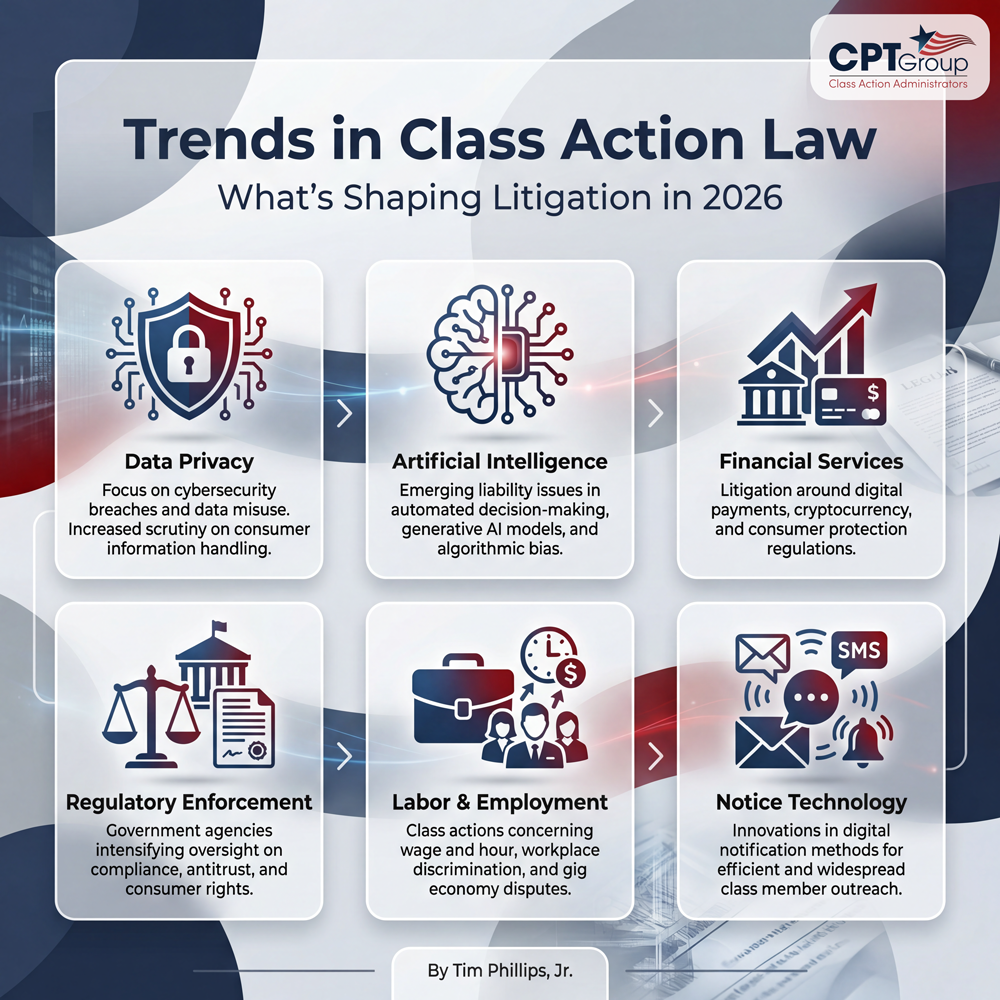
Class action litigation continues to be one of the most dynamic areas of civil law, serving as a powerful mechanism for aggregating claims, promoting access to justice, and holding corporations accountable. Rapid changes in technology, regulatory enforcement, and judicial doctrine have reshaped how class actions are filed, litigated, and resolved. Below are the major trends defining class action law in 2026.
01 DATA PRIVACY
Data Privacy and Cybersecurity Class Actions
With digital transformation touching every industry, class actions grounded in data privacy and cybersecurity failures have surged. State privacy laws such as the California Consumer Privacy Act[1] and similar statutes nationwide have opened new avenues for litigation. Under the CCPA, consumers whose nonencrypted personal information is exposed due to a business's failure to implement reasonable security practices may bring a private right of action seeking statutory damages of $100 to $750 per individual, per incident.[2] Courts continue to wrestle with issues such as standing, injury-in-fact, and damages in cases involving data exposure.
Plaintiffs increasingly allege non-economic harms, including loss of control over personal data. A recent line of federal decisions has tested the boundaries of the CCPA's private right of action, including claims beyond the traditional data breach context to include allegations that businesses disclosed personal information to third-party technology providers through the use of website tracking tools without consumer consent.[3] Settlements often include both monetary compensation and injunctive relief requiring enhanced cybersecurity practices.
Courts also continue to apply the Supreme Court's 2021 decision in TransUnion LLC v. Ramirez[4] to data privacy class actions, scrutinizing whether putative class members can demonstrate a concrete, particularized injury sufficient to confer Article III standing. Additionally, plaintiffs are increasingly pairing CCPA claims with causes of action under the California Invasion of Privacy Act, which provides a broader private right of action and higher statutory damages.[5] For businesses, this trend highlights the need for strong data governance, documented security controls, and comprehensive breach response planning.
02 ARTIFICIAL INTELLIGENCE
Artificial Intelligence and Algorithmic Liability
Artificial intelligence is quickly becoming a new frontier in class action litigation. As AI systems are used in hiring, lending, healthcare, advertising, and pricing decisions, plaintiffs are testing theories of liability based on algorithmic bias, deceptive practices, and unfair competition. In a notable decision, the U.S. District Court for the Northern District of California held that a third-party AI vendor could be held directly liable as an "agent" of the employers who used its applicant screening platform under Title VII, the ADEA, and the ADA.[6]
Claims frequently focus on alleged disparate impact, lack of transparency, and improper data usage. In May 2025, the same court granted preliminary certification of a nationwide collective action under the ADEA, recognizing the common question of whether the vendor's AI recommendation system had a disparate impact on applicants over forty as appropriate for collective resolution.[7] The EEOC has issued guidance addressing adverse impact in AI-based employment selection procedures,[8] and several jurisdictions, including New York City, have enacted legislation requiring employers to conduct independent bias audits of AI hiring tools.[9] Organizations deploying AI tools must ensure governance frameworks, bias testing, and compliance oversight are in place.
03 FINANCIAL SERVICES
Consumer Financial Services Litigation
Class actions in the financial services sector remain steady and complex. Cases commonly involve alleged violations of federal and state consumer protection statutes, improper fee practices, and disclosure failures.
As financial services become increasingly digital, litigation often centers on app-based disclosures, online account agreements, and algorithm-driven decisions. This shift raises novel questions about consumer consent, notice adequacy, and contract formation in digital environments.
04 REGULATORY ENFORCEMENT
Regulatory Enforcement as a Catalyst
Government investigations and enforcement actions often trigger follow-on class litigation. When agencies announce settlements or findings, plaintiffs' firms frequently file parallel civil suits relying on similar factual allegations.
This parallel exposure creates significant risk for companies facing regulatory scrutiny. Strong compliance programs and proactive internal audits can reduce the likelihood of both regulatory penalties and subsequent private litigation.
05 LABOR & EMPLOYMENT
Labor and Employment Class Actions
Wage and hour litigation continues to generate substantial class and collective actions. The Fair Labor Standards Act[10] and its state-law counterparts form the basis for most of these claims. Issues commonly include worker misclassification, overtime disputes, and pay equity claims. The growth of remote work and gig-based labor models has added complexity to classification and compliance analyses. In March 2024, the Department of Labor finalized a revised rule adopting a multifactor economic reality test to assess whether workers are employees or independent contractors under the FLSA.[11]
Arbitration agreements and class waivers remain heavily litigated. In Epic Systems Corp. v. Lewis,[12] the Supreme Court held that the Federal Arbitration Act requires courts to enforce mandatory arbitration agreements that include class action waivers. Courts continue to carefully analyze enforceability under both federal and state law, including when delay in invoking arbitration may constitute a waiver of that right.[13]
06 PROCEDURAL DEVELOPMENTS
Procedural Developments and Notice Technology
Class certification remains the central battleground in most cases. Federal Rule of Civil Procedure 23(b)(3)[14] requires that plaintiffs demonstrate common questions of law or fact predominate over individual questions and that a class action is the superior method of adjudication. Courts continue to demand rigorous proof that damages models align with liability theories. The Supreme Court's holding in TransUnion LLC v. Ramirez[15] further requires that every class member demonstrate a concrete, particularized injury sufficient to confer Article III standing to recover individual damages.
At the same time, notice practices are evolving. Federal Rule of Civil Procedure 23(c)(2)(B)[16] requires that notice in a Rule 23(b)(3) action be provided in a manner reasonably calculated to apprise interested parties of the pendency of the action. Digital notice programs using email, SMS, and targeted online advertising are increasingly accepted by courts as effective methods for reaching class members. Settlement administration processes are becoming more data-driven and technologically advanced.
What This Means for Businesses
Organizations facing potential class action exposure should prioritize proactive risk management. This includes strengthening compliance frameworks, reviewing arbitration provisions, auditing disclosures, investing in cybersecurity infrastructure, and implementing effective incident response protocols.
Early motion practice, strategic mediation, and data-informed settlement planning remain key tools for managing risk and controlling litigation costs. Class action litigation is likely to remain robust as technological innovation, regulatory oversight, and consumer expectations continue to evolve. Companies that invest in transparency, governance, and compliance will be better positioned to mitigate exposure and respond effectively when claims arise.
ABOUT THE AUTHOR
Tim Phillips, Jr.
With over 20 years in the attorney services and litigation support industry — and more than 15 years at CPT Group — Tim brings deep expertise and enduring client relationships to his role as a senior member of the sales team. His leadership in sales, consulting, and marketing has helped position CPT as a premier Class Action Settlement Administrator nationwide.
Tim is widely recognized as a top consultant on wage-and-hour, data breach, and consumer-protection class actions in California, contributing to more than 200 settlements annually.
ENDNOTES
1. Cal. Civ. Code § 1798.100 et seq. (West 2020).
2. Cal. Civ. Code § 1798.150(a)(1) (West 2020).
3. Shah v. Capital One Fin. Corp., No. 24-CV-05985-TLT, 2025 WL 714252 (N.D. Cal. Mar. 3, 2025); M.G. v. Therapymatch, Inc., No. 23-CV-04422-AMO, 2024 WL 4219992 (N.D. Cal. Sept. 16, 2024); In re BetterHelp, Inc. Data Disclosure Cases, 2024 WL 3416511 (N.D. Cal. July 15, 2024).
4. TransUnion LLC v. Ramirez, 594 U.S. 413 (2021).
5. Mirmalek v. L.A. Times Commc'ns LLC, 2024 WL 5102709 (N.D. Cal. Dec. 12, 2024); Cal. Penal Code § 637.2.
6. Mobley v. Workday, Inc., No. 23-CV-770, slip op. (N.D. Cal. July 12, 2024).
7. Mobley v. Workday, Inc., 2025 WL 1424347 (N.D. Cal. May 16, 2025).
8. EEOC, Select Issues: Assessing Adverse Impact in Software, Algorithms, and Artificial Intelligence Used in Employment Selection Procedures Under Title VII of the Civil Rights Act of 1964 (May 2023).
9. N.Y.C. Admin. Code § 20-871 et seq. (2023) (Local Law 144).
10. Fair Labor Standards Act of 1938, 29 U.S.C. §§ 201-219.
11. U.S. Dep't of Labor, Employee or Independent Contractor Classification Under the Fair Labor Standards Act, 89 Fed. Reg. 1638 (Jan. 10, 2024) (effective Mar. 11, 2024).
12. Epic Sys. Corp. v. Lewis, 584 U.S. 497 (2018).
13. Quach v. California Commerce Club, Inc., 16 Cal. 5th 562 (2024).
14. Fed. R. Civ. P. 23(b)(3).
15. TransUnion LLC v. Ramirez, 594 U.S. 413, 431 (2021).
16. Fed. R. Civ. P. 23(c)(2)(B).
This content is provided for informational purposes only and does not constitute legal advice.